
How to Audit AI Search Visibility for a Construction Company
Most construction companies still judge online visibility by Google rankings, website traffic and enquiry numbers.
Those metrics still matter. But they no longer show the full picture.
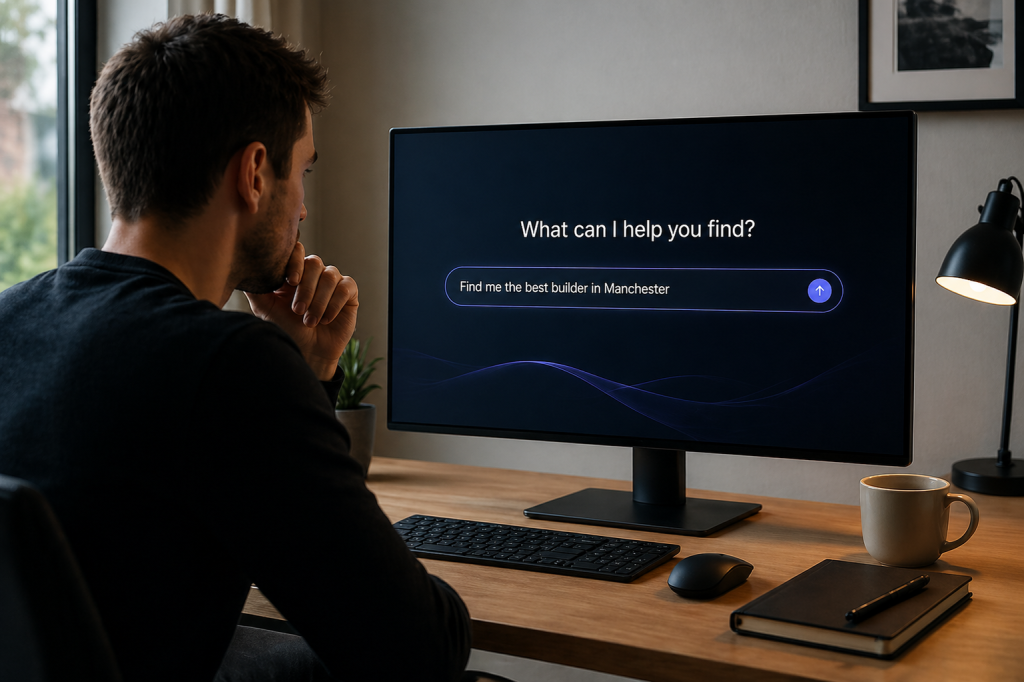
Clients, developers, homeowners, procurement teams and commercial buyers are now using AI search tools such as ChatGPT, Google AI, Gemini and Perplexity to research companies, compare options and understand who looks credible.
That creates a new problem for contractors.
A construction company may rank well in Google, but still be invisible, misunderstood or ignored inside AI-generated answers.
This guide explains how to audit AI search visibility properly, what to check, what the results mean, and how to run a fast first-pass check using Construct Virtual’s Free AI Check for Construction Businesses.
What Is an AI Search Visibility Audit?
An AI search visibility audit checks whether AI search systems can find, understand and recommend your construction business.
- It is not the same as a normal SEO audit.
- A normal SEO audit asks questions like:
- Can Google crawl the website?
- Are the service pages optimised?
- Do pages rank for target keywords?
- Is the site technically healthy?
- Is the content useful and relevant?
- Do AI systems mention competitors but not you?
- Is your business described accurately?
- Are your projects, reviews and trust signals strong enough to support recommendations?
This matters because AI systems do not simply display ten blue links. They summarise, compare, recommend and sometimes exclude. This connects closely with LLM optimisation for construction companies, where the focus is on making services, locations, project evidence and trust signals easier for AI systems to understand.
For construction companies, that can directly affect trust before a potential client ever reaches your website.
Why AI Visibility Matters for Construction Businesses
Construction is a high-trust industry.
A client is not usually looking for the cheapest click. They are looking for proof that a company can deliver the work safely, professionally and reliably.
That means AI search systems look for signals that support confidence.
For a construction business, those signals may include:
- Clear service pages
- Accurate location coverage
- Detailed project examples
- Sector experience
- Customer reviews
- Professional accreditations
- Authoritative content
- Consistent business information
- Strong internal linking
If those signals are missing, weak or scattered, AI tools may struggle to understand where the company fits.
The result is not always obvious. Your website may still exist in Google. Your brand may still appear when someone searches your exact name. But when a potential client asks an AI tool for “best commercial fit out companies in Cardiff” or “builders for house extensions in North London”, your company may not appear at all. If you are unsure how these terms fit together, our guide to SEO vs GEO vs LLMO for construction companies explains the difference between traditional rankings, generative engine optimisation and large language model optimisation.
That is the visibility gap this audit is designed to find.
This is the exact focus of our AI search visibility service.
The First Thing to Check: Entity Recognition
Before testing service keywords, check whether AI systems recognise the business as an entity.
Ask simple brand prompts:
- What is [Company Name]?
- What does [Company Name] do?
- Where is [Company Name] based?
- Is [Company Name] a construction company?
- What services does [Company Name] provide?
- Who owns or runs [Company Name]?
- A strong result should accurately describe the company.
- A weak result may be vague, incomplete, outdated or wrong.
For example, if a builder is described only as a “home improvement company” when it actually delivers extensions, loft conversions and refurbishments, the AI system has not understood the business properly.
If a commercial contractor is described without mentioning sectors, project types, or locations, the company has an entity-clarity problem.
This is one of the most overlooked parts of AI search visibility. AI systems need to know what the business is before they can confidently recommend it.
Check Service and Location Visibility
Next, test whether the company appears for service and location prompts.
For construction companies, this is where most commercial visibility is won or lost.
Use prompts such as:
- Who are the best [service] companies in [location]?
- Which [trade] companies work in [location]?
- Recommend a [service] contractor near [location].
- Who provides [service] for commercial buildings in [location]?
- What companies should I consider for [project type] in [location]?
- For example:
- Who are the best office fit-out companies in Cardiff?
The goal is not just to see whether the company appears. The goal is to see whether AI understands the correct service, location and project context.
A useful audit records:
- Whether the business was mentioned
- Which competitors appeared
- Whether the website was cited
- Whether third-party sources were cited
- Whether the description was accurate
Check Competitor Presence
AI search is comparative by nature.
A buyer rarely asks only about one company. They ask who is best, who is trusted, who works in a region, or which companies are worth shortlisting.
That means your audit should compare your business against known competitors.
Test prompts like:
- Compare [Your Company] with [Competitor].
- Who is better known for [service] in [location], [Company A] or [Company B]?
- Which companies are recommended for [service] in [location]?
- What are the most credible [sector] companies in [region]?
Look for three things.
- First, whether competitors appear more often than you.
- Second, whether competitors are described with stronger evidence.
- Third, whether AI systems have greater confidence in competitors’ services, projects, reviews, or locations.
This can reveal the real weakness. Sometimes the issue is not that your website is poor. It is that competitors have clearer project pages, better reviews, stronger local signals or more consistent external mentions.
Check Description Accuracy
Visibility is not enough.
A construction company can appear in AI search and still be misrepresented.
This is especially risky for companies that have changed services, expanded into new sectors, moved location, renamed the business or redesigned the website.
Check whether AI systems accurately describe:
- Services
- Locations
- Sectors
- Project types
- Business size
- Specialisms
- Accreditations
- Contact details
If the answer is wrong, the issue needs to be diagnosed.
Common causes include:
- Thin service pages
- Conflicting old content
- Weak About page information
- Poor schema
- Old directory listings
- Inconsistent Google Business Profile data
AI systems are only as confident as the evidence they can find. If the evidence is unclear, the answer often becomes unclear too.
Check Project Evidence
Construction companies have a major advantage in AI search if they use project evidence properly.
Many businesses do not.
They upload galleries, but do not explain the project. They mention services, but do not connect them to real work. They show finished photos, but do not describe the site conditions, scope, location, constraints or outcome.
For AI search, that is a missed opportunity.
A strong project page should include:
- Project location
- Service category
- Building type
- Client type where appropriate
- Scope of works
- Constraints
- Materials or systems used
This helps AI systems connect the business with real services, real places and real proof.
For example, “office refurbishment” is a service claim. But “office refurbishment for a commercial landlord in Cardiff involving partitions, suspended ceilings, lighting coordination and phased handover” is evidence.
AI search visibility depends heavily on that difference.
Not sure where your business appears? Run Construct Virtual’s Free AI Check for Construction Businesses before carrying out a deeper audit.
Check Technical AI Readiness
There is no magic schema that guarantees inclusion in AI answers.
However, technical SEO still matters because AI search systems depend heavily on crawlable, understandable, well-structured content.
A construction company website should be checked for:
- Indexable service pages
- Clear internal links
- Logical site architecture
- Descriptive title tags
- Accurate meta descriptions
- Structured headings
- Visible text content
This is not about tricking AI systems. It is about removing friction.
If a page is hard for Google to crawl, thin in visible text, poorly linked internally or unclear in structure, it is also less useful as an evidence source for AI search. Technical SEO still matters, which is why this audit should sit alongside a wider SEO for Construction Companies strategy.
Use Construct Virtual’s Free AI Check First
For a fast first step, use Construct Virtual’s Free AI Check for Construction Businesses.
The check is designed for contractors, builders, developers and trade businesses that want to know whether they are visible in AI-assisted search.
You enter:
- First name
- Last name
- Business name
- Trade or sector
- Location
- Website
The tool then provides a quick first-pass indication of where the business stands in terms of AI visibility.
This is not a full manual audit. It is a starting point.
It helps answer the question most construction businesses have not checked yet:
Is your business invisible on AI?
If your company is not being recognised, described correctly or connected with the right services and locations, the next step is a deeper AI Search Visibility audit.
What a Deeper AI Visibility Audit Should Include
A full construction AI visibility audit should go beyond surface-level prompts.
It should examine:
- How AI systems describe the business
- Whether the company appears for service-location searches
- Which competitors are recommended instead
- Whether project evidence supports the right services
- Whether reviews and trust signals are strong enough
- Whether business information is consistent across platforms
- Whether technical SEO supports AI discoverability
- Whether schema matches visible content
What Good AI Visibility Looks Like
A construction company with strong AI visibility usually has several things in place.
- The business is clearly understood.
- Its services are described accurately.
- Its locations are consistent.
- Its project evidence supports its claims.
- Its reviews reinforce trust.
- Its website is easy to crawl and interpret.
- Its content answers real buyer questions.
- Its internal links connect services, locations and proof.
- Its third-party mentions support the same business identity.
When those signals work together, AI systems have more confidence in the company.
That does not guarantee inclusion in every AI answer. No agency can honestly promise that.
But it does improve the evidence base that AI search systems can use when deciding which companies to mention, cite or recommend.
So What’s Next?
AI search visibility is not a replacement for SEO.
It is the next measurement layer.
Construction companies still need strong websites, useful content, technical SEO, local visibility and conversion-focused pages. But they also need to know whether AI systems can understand who they are, what they do, where they work and why they should be trusted. For trade businesses, AI SEO for Trades helps connect service pages, local search, reviews and AI visibility into one joined-up search strategy.
That starts with a simple check.
Run Construct Virtual’s Free AI Check for Construction Businesses to see whether your company is visible, understood and ready for the next stage of search.