
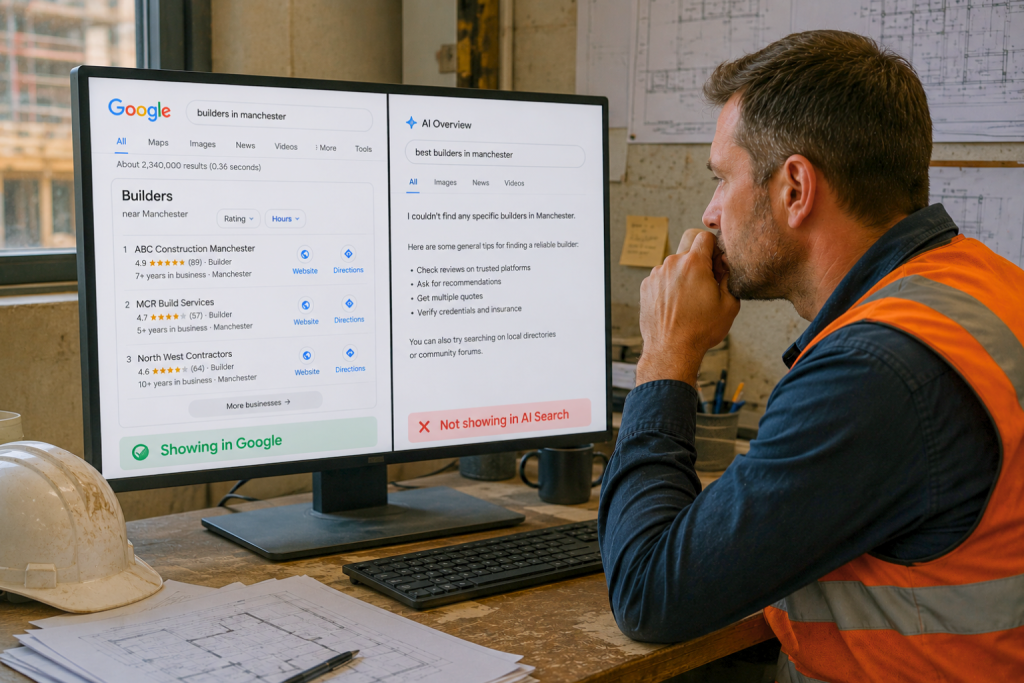
A potential client in your area went looking for a contractor last week. They did not open Google and scroll through a page of links. They opened an AI assistant and typed something close to: “Who are the best commercial contractors in [their town]?”
The assistant gave them three names.
Yours was not one of them.
That is not a comment on the quality of your work. It is a comment on how much reliable, consistent information the AI had to draw on when it decided who to put forward. For most construction companies, the honest answer is: not enough.
This is not a Google problem. It is a different problem, it behaves differently, and the fixes are different too. This article explains what AI visibility is, why a construction company can rank well on Google and still be missing from AI recommendations, what signals these systems actually draw on, and what you can check about your own business today.
The client you never knew you lost
When you lose a tender, you usually know about it. There is a decision, a phone call, a line in an email. You can point to the job that got away and, often, work out why.
The enquiries you lose to AI are quieter than that. There is no rejection, because there was never a conversation. The buyer asked an assistant for a shortlist, your name was not on it, and they contacted the firms that were. You never saw the enquiry, so you never knew it existed. Nothing appears in your pipeline. Nothing appears in your reporting. The work simply goes elsewhere.
This is happening more often than most owners realise, because buyer behaviour has shifted quickly. Hundreds of millions of people now use ChatGPT every week, Google’s AI Overviews sit above the traditional results on a large share of searches, and other assistants such as Perplexity and Microsoft Copilot are being used the same way. A growing number of those searches are the local, “who does this near me” queries that construction buyers have always relied on.
The important shift is not that AI exists. It is that the shortlist now forms earlier. In the past, a buyer searched, browsed a few websites, and built their own list. Increasingly, an assistant hands them a list that is already narrowed to two or three names. If your firm is not among them, you are not losing on price or on quality. You are not in the conversation at all.
What is AI visibility, and why it matters now
AI visibility is how likely an AI system is to mention or recommend your business when someone asks it a relevant question. It depends less on where a single web page ranks and more on how clearly, consistently and credibly your business is described across the sources these systems learn from.
Traditional online visibility was about one destination: your position in Google’s results. AI visibility is about something broader. It is about whether the wider web describes your business clearly enough, and consistently enough, that an AI system can recommend it with confidence.
The reason this matters now, rather than at some vague point in the future, comes down to reach and momentum. AI-assisted search has moved from novelty to habit in a very short space of time. Google’s AI Overviews alone are seen by billions of people each month and now appear on a large proportion of searches, including local service queries. ChatGPT’s weekly audience runs into the hundreds of millions. These are not early-adopter numbers. This is mainstream behaviour.
There is also a compounding effect that works against the companies who wait. Every consistent listing, every recent review, every piece of clear, location-specific content strengthens the signal around a business over time. A firm that starts building those signals now is not simply catching up later. It is building a position that becomes harder for a competitor to overtake the longer that competitor leaves it. Twelve months of consistent signal is difficult to replicate in an afternoon.
Google ranking and AI visibility are not the same thing
For twenty years, being visible online meant ranking on Google. You built a decent website, gathered some reviews, and worked your way up the results for the searches that mattered to you. That model is well understood, and most established construction firms have invested in it to some degree.
AI search works differently, and the difference is mechanical, not cosmetic.
When someone asks ChatGPT, Google’s AI Overviews, Perplexity or Microsoft Copilot to recommend a construction company, the system is not scrolling a ranked list of web pages in real time and reading yours from top to bottom. It is drawing on a picture of your business that has been assembled from many sources: structured data, citations, reviews, directory listings, published content and the general pattern of how your firm is described across the internet. It is weighing how consistent and trustworthy that picture looks, and then it is putting forward the businesses it can describe with the most confidence.
That is why a construction company can rank respectably on Google and still be close to invisible inside AI recommendations. Google ranking rewards a strong page. AI recommendation rewards a strong, consistent, verifiable presence across the whole web. They overlap, but they are not the same thing, and doing well at one does not guarantee the other.
The difference in one line
Traditional SEO is about getting your own pages to rank. AI visibility is about whether AI systems have enough clear, consistent, trustworthy information about your business to recommend it. You can be good at one and poor at the other.
How AI decides which construction company to recommend
No two AI systems work in exactly the same way, and none of them publishes a fixed ranking formula. Anyone who tells you they know the precise algorithm is guessing. But the types of signal these systems can draw on are reasonably well understood, and, usefully, most of them are within your control.
- Consistency of your business information. This is the foundation, and it is where a surprising number of established firms fall down. If your company name, address, phone number and description of services appear differently in different places across the web, that inconsistency makes it harder for any system to be confident it is describing the same business. A firm listed as “ABC Construction Ltd” in one place, “ABC Construction” in another, and “ABC Builders” in a third has quietly created three weaker signals instead of one strong one.
- Structured data on your website. Structured data is a way of labelling the information on your site so machines can read it reliably rather than inferring it. It tells a system, in plain terms, that this is your business name, this is where you operate, these are the services you offer, this is a review. A well-designed page with no structured data still looks good to a human, but it gives a machine less to work with.
- Reviews. AI systems can draw on how many reviews you have, how recent they are, what they actually say, and whether they appear on more than one platform. A steady flow of recent, specific reviews across a couple of platforms is a stronger signal than a burst of reviews from three years ago on a single one.
- Citations and mentions on third-party sites. When trade directories, industry bodies, supplier pages, local press and other credible sites mention your business, and describe it consistently, that reinforces the picture. These third-party references matter partly because they are harder to fabricate than your own marketing, so they tend to carry weight.
- Published content that answers real questions. Content tied to the type of work you do and the areas you serve helps a system understand what you actually do and who you do it for. A page that clearly explains your commercial fit-out work in a particular region is more useful to an AI system than a generic paragraph on an “about us” page.
How does AI decide which construction company to recommend?
In short: an AI system draws on the information available to it about your business, weighs how consistent and trustworthy that information looks, and recommends the firms it can describe with the most confidence. There is no single formula, results can differ between systems, and they can change over time.
Why a good website isn’t enough
Here is the part that catches a lot of well-run firms out. Your website is necessary. On its own, it is not enough.
When a buyer asks an AI assistant for a recommendation, the system is usually not visiting your site for the first time and forming a fresh opinion on the spot. It is leaning on a picture it has already built from many sources. If that picture is thin, a smart website does very little to change the answer in the moment the buyer is asking.
Picture two firms bidding for the same commercial fit-out. One has a good website and little else. The other has the same quality of website, plus a complete and accurate Google Business Profile, recent reviews across two or three platforms, a handful of trade directory listings that all describe the business the same way, and a few pages that answer the exact questions clients ask about that type of project. Ask an AI assistant to recommend a contractor for that job, and the second firm is far easier to put forward with confidence. Not because its work is better, but because there is more for the system to stand on.
This is the trap for a lot of construction companies in the £1M to £10M range. They have invested seriously in their website and their Google presence, and almost nothing in the structured information, reviews and third-party mentions that AI systems actually lean on. The site looks the part to a human. To a machine trying to decide who to recommend, there is very little to hold onto.
Where construction companies most often fall short
In practice, the gaps tend to be the same ones from firm to firm. If any of these sound familiar, they are worth looking at.
- Business details that have drifted over the years. Old directory profiles, a previous office address, a mobile number that has changed, a trading name used in some places and the registered name in others. Each inconsistency chips away at the signal.
- Reviews that live in only one place. Plenty of good firms have solid Google reviews and nothing anywhere else. That is better than nothing, but a presence across more than one platform is stronger and more credible.
- Websites written entirely for humans. A site can be well designed and well written and still contain no structured data at all, which means a machine has to guess at the basics rather than read them.
- A thin or absent third-party presence. If the only place your business is described in any detail is your own website, there is nothing external to corroborate it. Credible mentions elsewhere do a lot of quiet work.
- No location or service-specific content. A single generic services page tells a system far less than clear pages covering the specific work you do and the specific areas you cover.
- Dormant and duplicate listings. Abandoned profiles on directories, or two versions of the same listing with slightly different details, actively muddy the picture rather than help it.
None of these is dramatic on its own. Together, they are the difference between a business a system can describe confidently and one it cannot.
Common objections, answered honestly
It is worth addressing the reactions this topic usually provokes, because some of them contain a grain of truth and some do not.
“We get most of our work through referrals.” Good, and referrals are not going anywhere. But a referred prospect very often checks a firm online before making contact, and increasingly that check involves an assistant. A weak or inconsistent presence can undermine a warm referral just as easily as it loses a cold search.
“AI gets things wrong, so why would I trust it?” Whether or not you trust it is beside the point. Your potential clients are using it, and they are acting on what it tells them. The question is not whether the technology is perfect. It is whether your business is described well enough that the technology can put you forward.
“Isn’t this just SEO with a new name?” No. The two overlap, and good fundamentals help both, but they reward different things. SEO rewards a strong page. AI visibility rewards a strong, consistent, verifiable presence across the web. A firm can do well at one and poorly at the other.
“We already rank number one on Google.” That is genuinely valuable, and it is worth protecting. It does not, by itself, guarantee that an AI system will mention you when a buyer asks for a recommendation, because the two are assembled differently.
“Our clients are traditional and don’t use AI.” Some of them do, and more will. Beyond that, the researcher, assistant or younger colleague who helps a senior decision-maker gather options very often does. And Google’s AI Overviews appear at the top of ordinary searches whether or not the person searching considers themselves an AI user at all.
Why this matters specifically for construction companies
Construction is a high-consideration purchase. Nobody appoints a contractor on a whim, and the sums involved mean buyers research, compare and shortlist carefully before they ever pick up the phone. Increasingly, that research starts with an assistant rather than a search engine.
That changes where the decision is really being made. By the time a prospect contacts you, the shortlist has usually already formed. If an AI system helped build that shortlist and your firm was not on it, you are not competing on price, quality or relationship, because you were never presented as an option.
The economics make this sharper for construction than for many other sectors. A single enquiry can be worth a great deal, and the number of serious enquiries a firm needs in a year is not large. Missing even a handful of shortlists, quietly and invisibly, over the course of a year is not a rounding error. It is a meaningful amount of work going to competitors who are simply easier for an assistant to recommend.
The other side of that is the opportunity. Most of your competitors have not addressed this either. The field is still open, and the firms that move while it is open are the ones that will be difficult to displace once it is not.
The AI visibility gap, and why acting now matters
This is not a switch you flip once and forget. AI visibility builds gradually. Every consistent listing, every recent review, every piece of genuinely useful, location-specific content adds to the signal, and the signal accumulates.
That is exactly why timing matters. A firm that starts strengthening these signals now is not just doing the same work its competitors will do later. It is building a lead over the period in which fewer businesses are paying attention. The companies that wait will be trying to establish in a hurry what their more visible competitors have spent months quietly building, and consistency built over time is hard to fake at short notice.
None of this means AI visibility replaces SEO, or that a good Google ranking no longer matters. It does. It means there is now a second, related job to do, and that job has been largely ignored across the construction sector so far.
What to check before your competitors do
You do not need a strategy document to get a feel for where you stand. You need about ten minutes and a little honesty.
Start by asking. Open an AI assistant and put to it the questions your clients would ask. “Who are the best commercial contractors in [your town]?” “Who does [the kind of work you do] in [your region]?” See whether your firm comes up at all, and take note of which competitors do. It is often a sobering exercise.
Then check the basics. Is your Google Business Profile complete, accurate and up to date? Do your reviews appear on more than one platform, and are any of them recent? Is your website structured so a machine can read the important details, or only styled so a human can? Do the third-party sites that mention your business describe it the way you would? Search for your own business name, and its variations, and see whether the picture that comes back is consistent.
You will usually find at least one or two gaps quickly. Most owners have never checked what an assistant says about their company, and the first look is almost always revealing.
What can a construction company do to improve its AI visibility?
Make your business information consistent everywhere it appears. Keep your Google Business Profile complete and current. Encourage recent reviews across more than one platform. Add structured data to your website so the key facts are machine-readable. Publish clear content that answers the real questions your buyers ask about the work you do and the areas you serve. Tidy up dormant and duplicate listings. None of it is complicated in isolation. The work is in doing it deliberately, and keeping it consistent over time.
Find out where you stand
Want to know how visible your construction business is to AI? If you have never checked, it is the quickest way to find out whether potential clients are being shown your competitors instead of you.
Free. Around 60 seconds. See exactly where your business is being missed and what an AI assistant can and cannot confidently say about your firm today.
Check your AI visibility →Google ranking rewards a strong page. AI recommendation rewards a strong, consistent, verifiable presence across the whole web.
Frequently asked questions
›What is AI visibility?
AI visibility is how likely an AI system is to mention or recommend your business when someone asks it a relevant question. It reflects how clearly and consistently your business is described across the sources these systems draw on, rather than where a single web page ranks.
›What is the difference between SEO and AI visibility?
Traditional SEO is about getting your own pages to rank in search results. AI visibility is about whether AI systems have enough clear, consistent and trustworthy information about your business to recommend it. The two overlap, but you can do well at one and poorly at the other.
›Can a construction company rank well on Google but be invisible to AI?
Yes. Google ranking rewards a strong web page. AI recommendation draws on a broader, assembled picture of your business from across the web. A firm with a polished website and thin or inconsistent wider signals can rank on Google and still be absent from AI recommendations.
›How does AI decide which construction company to recommend?
It draws on the information available about your business, weighs how consistent and trustworthy that information looks, and recommends the firms it can describe with the most confidence. Signals can include consistent business details, structured data, reviews, third-party citations and relevant published content. There is no single formula, and results can vary between systems.
›What can a construction company do to improve its AI visibility?
Keep business information consistent everywhere, maintain a complete Google Business Profile, gather recent reviews across more than one platform, add structured data to the website, publish content that answers real client questions, and clear up dormant or duplicate listings.
›Does AI visibility replace SEO?
No. A good Google ranking still matters. AI visibility is a related but separate task that most construction firms have not yet addressed. The two work best together.
Next up in the AI Visibility Series: what LLMs actually look for when recommending a construction company.
More Reading
Connect with construction businesses already using AI to win more of the right work.
Until next week,
The Construct Virtual Team
Operations, Marketing and AI Systems for Construction Businesses.